| HOME | OVERVIEW | MEDIA CENTRE | MATERIALS | SOUTH AFRICA TODAY | THE SCENARIOS | REFERENCES | EVENTS |
 |
| Currently viewing: South Africa today / Our Liabilities / Social Challenges |
|


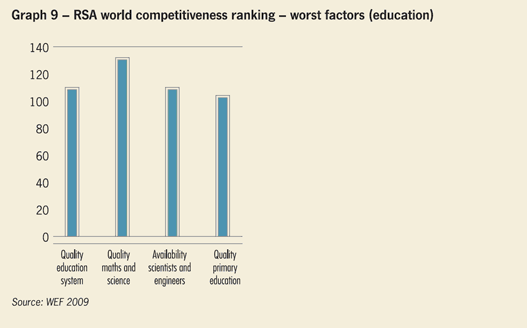
OUR LIABILITIESSocial Challenges Fifteen years into democracy our social fabric and social cohesion remains fragile, bedeviled by poverty and racial inequality, deteriorating educational and health conditions and a citizenry besieged by crime. Education The legacy of unequal apartheid education crippled the country; it not only truncated the dreams and aspirations of the majority of people, it suffocated future development. Apartheid not only violated human rights, but deliberately underdeveloped the majority of its people. In spite of government's best efforts, our education system is faltering. South Africa ranks among the lowest in the world on basic literacy and numeracy skills. In terms of the quality of mathematics and science education, South Africa ranks 132nd out of 134 countries surveyed by the World Economic Forum. "We are number last," as one Scenario Team member put it.44
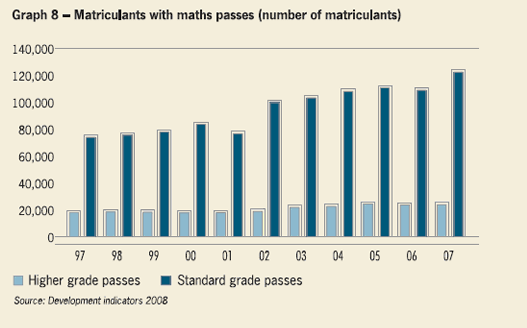
While the total number of matric mathematics passes increased between 1997 and 2007, from 95,000 to 149,228, less than 5% of matriculants achieved a higher grade pass and nearly 200,000 students failed their matric completely in 2007.45 Few school-leavers proceed to tertiary education. In 2008, of the 333,604 matriculants who passed, only 20% achieved a university entry pass. The World Economic Forum ranks an "inadequately educated workforce" as the most problematic factor for doing business in South Africa, followed by crime and theft, inadequate supply of infrastructure, and inefficient government bureaucracy. The schools in poorer communities mirror the legacy of the apartheid education system, in spite of government's commitment to equitable education. Nearly half of all schools, most in poor communities, have extremely poor infrastructure: 79% have no libraries, 60% have no laboratories and 68% have no computers. The problems of access to education in poor communities are compounded by malnutrition and the impact of HIV/Aids. A study in 2003 showed that 7% of children were "often or always hungry" and that 17% were "sometimes hungry".46 The problems in our education system relate directly to a lack of managerial capacity and accountability.
Many teachers lack commitment to the profession. A significant proportion of teachers are under-qualified, demoralised and lack professionalism. We have the highest rate of teacher unionism in the world (over 80%). While it is commendable that teachers are well organised, the commitment of the teacher unions to the all important job of ensuring that our children are properly taught is perhaps questionable. Despite the legal requirement to establish governing bodies, there are few effective mechanisms by which parents can hold teachers accountable, particularly in poor communities with poor literacy rates. In some instances, teachers on the payroll are even full-time members of municipal councils, without any challenge by the education authorities. Conversely, those schools where there is strong management and professional commitment, even in the poorest areas, have consistently produced better results.
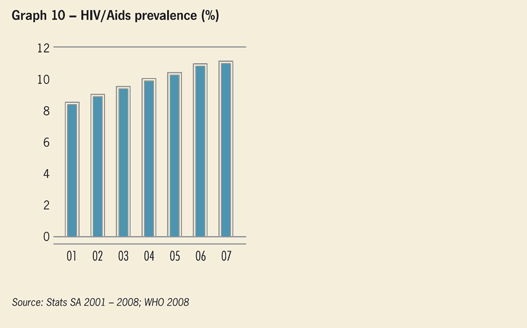
While the problems in education relate directly to a lack of professionalism, managerial capacity and accountability, government cannot solve the problem alone; parents, trade unions, civil society and the private sector need to rise to the challenge: we cannot tolerate our children being "number last". Health In spite of the increased investment in public health, our deteriorating critical health indicators continue to cause alarm. We have the fourth highest rate of infection of HIV/Aids in the world.47 Government's ambivalent and inadequate response to the epidemic proved to be fatal, resulting in an estimated 350,000 deaths and leaving behind 1.4 million orphans throughout the country in 2007.48 The disease has affected teachers, nurses, parents, young workers. Their deaths have impoverished families by removing breadwinners, leaving grandparents to care for children on their meagre pensions. Young women have been particularly affected, indicating their vulnerable status in society.
Government's belated response saw a delayed rollout of ARVs and of testing and counselling sites. By September 2007, a cumulative total of 408,000 people had been put on ARV treatment at 316 public healthcare sites. Vigorous civil society interventions, through organisations such as TAC, have helped to ensure that we now have the largest ARV roll-out programme in the world. However, despite expenditure of more than R3 billion
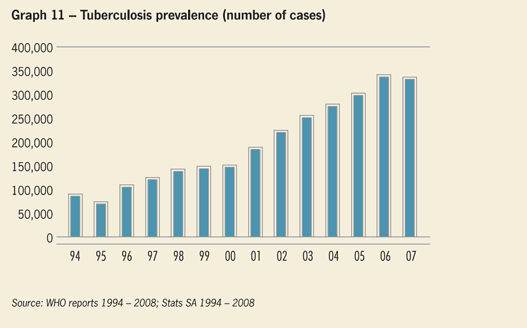
(budgeted for 2008/09) on the HIV/Aids programmes alone, some provincial clinics have run out of the life-saving drugs.49 We also have the fourth highest rate of TB infection in the world. In spite of a higher "cure rate" from 50% in 2004/05 to 60% in 2007/08, it is still the leading cause of premature death in the country, and is directly linked to the HIV/Aids epidemic. Multi-drug resistant and extreme-drug resistant TB has also strained the system, with about 600 people dying from the disease in 2007.50
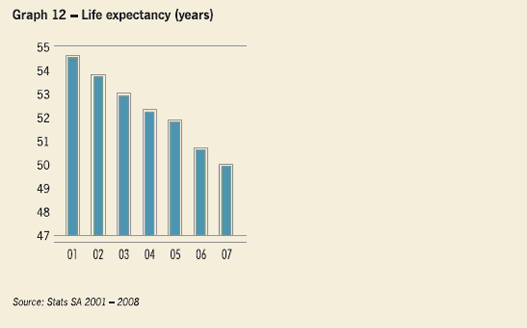
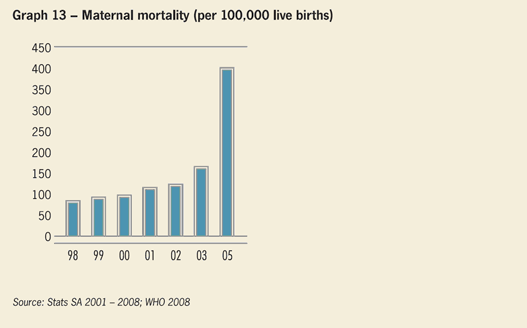
The impact of HIV/Aids and TB on our critical health indicators has been marked. Life expectancy has decreased from 63 years in 1990 to 51 in 2006. Other key indicators point to deep systemic problems in the public health system. For instance, the Stats SA Report of 2008, based on a comprehensive survey of mortality conducted in 2006, revealed that infant mortality rates per 1,000 live births have risen from 45 in 1990 to 56 in 2006, and our maternal mortality rate in 2005 was 400 per 100,000 live births. This is higher than most other countries in the SADC region.51
There has also been a significant flight of skills from the public healthcare sector, prompted by poor management, uncompetitive salaries and poor working conditions. In the early 1980s, 40% of doctors worked in the private sector, but by the late 1990s this proportion exceeded 70%; with one doctor for every 4,200 patients in the public sector, compared with one for every 600 in the private sector.52 One of the fundamental errors in health system reform has been the over-correction of the apartheid bias toward tertiary care at the expense of primary healthcare. As a result, there has been insufficient resourcing of the tertiary sector to provide high-level training and research for the entire health system. In addition, the closure of nursing colleges has devastated nursing capacity.
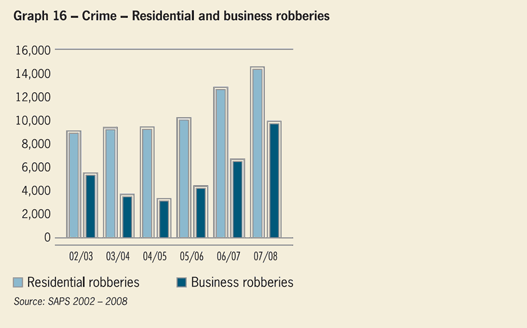
The crippling effects of the HIV/Aids and TB pandemics in South Africa, coupled with the pernicious mismanagement of public health resources, has seen a dramatic decline in life expectancy over the past 15 years, at a time when South Africa has experienced its longest period of sustained economic growth since the 1940s. The careless disregard for taxpayers and recipients of public healthcare has seen substantially more money thrown at the problem, without significant results, illustrating the lack of accountability of healthcare administrators in the country. Nor have critical voices and citizen action made government more accountable to the people, save for the Constitutional Court which forced government to deliver Nevirapine to prevent mother to child transmission of HIV/Aids. Crime A primary role of the state is the protection of citizens within its jurisdiction. The failure of government to ensure citizen safety has wreaked havoc in all communities, diminishing citizen trust in government, and has come at a great cost to our economic competitiveness and investor confidence in the country. The 2008 Ibrahim Index places South Africa 7th from the bottom of 49 countries in Africa in terms of the safety and security of citizens.53 Some government leaders, living in a cocoon of privileged protection, have been dismissive of the ravages of crime on the social fabric. "One senior government leader even belligerently warned citizens unable to cope with crime to emigrate. As if this is not sufficiently shocking, one police station found no shame in seeking protection from a private security firm, turning the SAPS into an object of ridicule." Crime remains a major threat to all communities in South Africa. The decline in violent contact crimes comes off a very high base. All sectors of society are badly affected. The vast majority of violent contact crimes occur in domestic or social environments and go largely unreported; a chilling testimony to the fragility of our social fabric. Aggravated robbery is the second-highest contributor to violent crimes, increasing substantially in 2007/08: house robberies were up by 14%, business robberies by 47% and truck hijacking by 40%. Ironically, 40% of these crimes occur in only 4% of police precincts.54
The capacity of the criminal justice system is weak and uneven. The DSO, popularly known as the Scorpions, which was established to investigate organised crime, became the first South African crime-fighting organisation to be recognised internationally for its successes. In its first year of operation, it achieved an 80% success (conviction) rate; successfully taking on 20 of the top organised crime syndicates and convicting crime barons on charges of money-laundering and racketeering. Their law enforcement operatives were trained abroad, thus building itself into a world-class organisation. The 'Hollywood-style' raids and prosecution of key political and government leaders have prompted the ruling party to disband the directorate. In terms of a parliamentary resolution, the DSO has been incorporated into the police service. The police are far less effective in securing convictions; moreover the head of the police force is facing corruption charges. The fact that most of the DSO's operations have not involved politicians, but organised crime syndicates, has escaped the politicians. Its dissolution must raise alarm bells for the future success in the fight against organised crime. While substantial resources were ploughed into combating organised crime, ordinary citizens face an under-resourced, under-trained, ill-equipped and demoralised police force. The wheels of justice turn slowly for ordinary people, stuck in the quagmire of an inefficient, incompetent criminal justice system. In poorer communities, people have given up hope that the police will protect them and resort to vigilantism. The weak police protection in poor neighbourhoods makes a mockery of the equality provisions of our Constitution. Middle class communities rely on private security companies to protect them. In 2008, private security guards outnumbered police officers by 2 to 1.55 "In contrast to the English and Black middle class, in previous times Afrikaner elites never used private institutions in schools, health and safety and security. So they ensured that public institutions functioned well and served their purpose. These days, the elites rely on private clinics, private security companies, private schools or model C schools. Are we surprised that these are areas where we are making little progress? Institutions, public or private, function optimally if the middle class have a vested interest in them and are prepared to put extra resources into them." The quintessential contract between successful states and their citizens is the contract of protection in exchange for loyalty and support. In the criminal justice system, the state is failing to deliver on its part of the contract.
|
VOICES OF DINOKENG
Perspectives from members of the Dinokeng Scenario Team. The apartheid system produced exactly what was intended. It was designed to produce illiterate black people. It’s no wonder that today we have vast numbers of people who cannot read and write. We see teachers and their unions going overboard. It is correct for unions to protect their members, but it is a problem when teachers say they can’t teach because they have to go to union meetings or go on a stayaway. The dominant teachers’ union has unwittingly become an effective conveyor of Bantu education by consistently resisting performancebased appraisals of teachers and quality supervision in schools. We are ashamed to say that things were better under apartheid. In education, if you compare us to other countries, we come number last! We should have had a war-like campaign against HIV/Aids. To wrap it up as poverty is the worst thing that could have been done. People don’t believe that medicines will be in the clinics. People don’t believe that the state can function in the way that it was crafted in our Constitution. There is a credibility deficit; a trust deficit. Our public hospitals are collapsing, driven by private sector development. The elite flocked to private hospitals and left the others behind. Living in a state of fear and violence becomes a cancer in society and it’s not gender, class or race specific. If it spirals, then the economy suffers, those who can leave do and the money to fix the problem shrinks. Cases abound of police brutality against vulnerable women: of a woman being locked up with males in jail cells, of women reporting domestic violence being raped at police stations. |