| HOME | OVERVIEW | MEDIA CENTRE | MATERIALS | SOUTH AFRICA TODAY | THE SCENARIOS | REFERENCES | EVENTS |
 |
| Currently viewing: South Africa today / Our Liabilities / Economic Development Challenges |
|


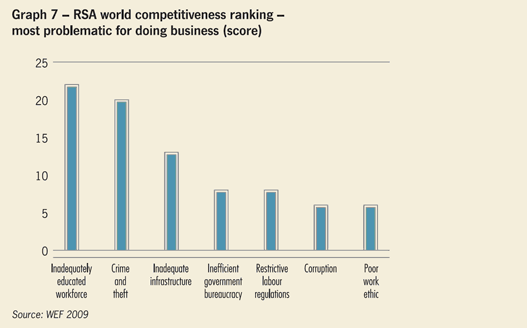
OUR LIABILITIESEconomic Development Challenges The chills of the global economic crisis expose our economic vulnerability and the underlying structural flaws in the economy. Macro-economic conditions Domestic economic growth has slowed down from an annual average of 5% in 2004 - 2007 to 3% in 2008. Rising interest rates in response to above potential GDP growth fuelled by strong credit growth, a widening current account deficit and high inflation have restricted consumer spending. Conditions in the global economy have deteriorated in the wake of the spillover from the subprime crisis. The volatility in financial and commodity markets both helped and hindered the domestic economy in 2008. Exports were initially boosted by higher prices and volumes, but have now been severely hurt as South Africa begins to feel the impact of the global economic crisis. Economic growth is expected to slow to 1.2% in 2009, the lowest rate since 1998.24 Among the more critical macro-economic challenges is growth in employment, managing inflation, ensuring sufficient earnings in foreign exchange and the maintenance of a healthy current account balance. The cost of doing business in South Africa also remains high, driven by a lack of competition, inadequate infrastructure, high input costs such as telecommunications, and an inflexible labour market in certain sectors. The WEF Global Competitiveness Index 2008/09 reveals that while South Africa ranks a favourable 45th out of 135 countries, the ranking has been gradually declining since 2000, and there are worrying underlying trends. South Africa ranks 88th in labour market flexibility, 123rd in flexibility of wage determination and 119th in poor labour-employer relations. With a university enrolment rate of only 15%, we rate 93rd, placing our innovation potential at risk.25
In terms of infrastructure, South Africa ranks 48th, with electricity supply slipping down to 101st from 83rd in 2007. The concern about crime and citizen safety is a serious obstacle to doing business in South Africa. The country ranks 134th out of 135 in terms of the costs of crime and violence to business. With respect to the health of the workforce, South Africa ranks 129th due to the high rates of communicable diseases.26 In some instances, BEE could serve as an inhibitor of new investment in South Africa, because it places restrictions on the ownership and management structures of firms: "Firm creation is the riskiest part of economic activity. Very, very few firms that are born survive, [but] some of those very few do grow. and become an important part of the economy. So reducing the chances of those firms being born is a problem."27 We have achieved much in the realm of macro-economic policy but key macro- and micro-economic challenges remain. Poverty and unemployment are exacerbated by the global crisis; the cost of doing business in South Africa is still too high; and skills shortages continue to act as a brake on growth. Skills development Skills shortage is a major constraint on growth. In 2007, there was an estimated shortage of 300,000 skilled workers.28 The unintended consequences of affirmative action have decreased the pool of skills, as skilled minorities have emigrated. In addition, the education sector is still not producing the type of skills the economy needs. The skills crisis is exacerbated by an inept Home Affairs department, which inhibits the global recruitment of skills. This ineptitude undermines South Africa's competitiveness, and leads to an exaggerated "brain drain" and missed opportunities for "brain gain". The Sector Education Training Authorities (SETAs), which absorb 1% of the total wage bill (estimated at no less than R6 billion for 2008 and expected to rise to R9 billion by 2011)29, have only been able to train 7,000 new workers per annum.30 The SETAs have thus not sufficiently developed or upgraded the skills needed in the country. In addition, they do not adequately address the problem of those outside the labour market. They are generally bureaucratic, inefficient and too often corrupt. As a tripartite institution set up by business, government and organised labour, the SETAs have not been held accountable for developing the skills of the South African working population, nor has business been sufficiently insistent and specific about their skills requirements. The private sector has also not sufficiently committed itself to training for the skills it needs. The lack of coordination between the labour and education departments further exacerbates the problem. There is a general malaise in producing the skills essential to a modern competitive economy. The SETAs have become 'convenient' vehicles to demonstrate business compliance in contributing to the skills levy, but little serious apprenticeship and technical training have taken place. The SETAs have disarticulated job training from the shop floor which is the virtue of apprenticeship training. The number of apprentices trained has dropped significantly compared with the apartheid period. In 1975, there were 33,000 apprentices registered in South Africa; by 2000 there were only 3,000. The Joint Initiative on Priority Skills Acquisition (JIPSA) unit estimated in 2007 that South Africa produced about 5,000 artisans a year, which will have to rise to 12,500 a year for the next four years to meet the demand for a projected increase of 30,000 over the period 2007 to 2010.31 The culpability of government for the closure of 100 technical colleges and 14 tertiary institutions for the amalgamation of universities and technikons in 2001, matches the culpability of organised business and labour for failing to collectively address the skills crisis.32 The failure of the tertiary sector to produce the requisite skills for a growing modern economy is fuelled by the poor quality of matriculants, weak management and poor academic performance at senior levels, and weak linkages between tertiary institutions and the private sector. Unemployment Despite the reduction of unemployment from 31% in 2003 to 23% in 2008, unemployment is still unacceptably high. Nearly a quarter of the working-age population looking for work is unsuccessful. Unemployment will be further exacerbated by the global economic crisis, which has led to a drop in demand for primary exports in the resources sector. The problem is particularly concentrated among the young, among women, among the unskilled and among Africans. There is a very high association between poverty and unemployment; most of the unemployed are concentrated in the poorest households. Unemployment in the lowest-income quintile (fifth) is 72%, compared with just 7% in the top quintile.33 Unemployment is closely linked to a lack of skills and education. The unemployment rate among those with university degrees is only 3%, for those with matric it is 28%, but for those without matric it is over 60%.34 Overall, there is an extremely high rate of unemployment among the youth. Over 50% in the 20 - 24 age category are unemployed. The demographic "youth bulge" indicates that it will pose even more severe problems later on, in terms of labour market supply and social cohesion, as the generation of unskilled, unemployed youth grows older.35
One of the most undesirable outcomes of youth unemployment is the rapid rise of petty crime and drug abuse in South Africa. This is further exacerbated by the high levels of violence inflicted on the youth. A study by the HSRC indicates that 38% of youth have experienced violence at home and 15% at school, and that 57% of youth have considered committing a crime.36 This is further underscored by the Poverty Hearings, conducted by the African Monitor in 2008, linking youth unemployment and an increase in crime.37 Perversely, there are numerous vacancies in the economy for skilled positions. This is testimony of the failure of our education and skills development systems to provide meaningful opportunities to our burgeoning youth. Deep structural flaws, going beyond 1994, constrain our model of economic development. The economy is not generating sufficient jobs for youth, women, unskilled and African people. Unemployment is closely linked to a lack of skills and education. Unless the root causes of youth unemployment are urgently addressed, we are reproducing a bleak generation with little hope in the future; a ticking time bomb. Poverty and inequality While 13 million people have now been included in the safety net of social grants, poverty remains a deep and daunting challenge. About 40% of households still live below a poverty line estimated by the Treasury to be about R480 per person per month. Poverty is closely linked to the structural problems of unemployment and the lack of skills; unemployment affects poor households most severely.38 Hunger remains a common denominator among poor people in South Africa. Testimonies from the African Monitor's 2008 Poverty Hearings consistently highlight that poor people still struggle with hunger and lack of nutrition. This affects their health and educational prospects, as well as reducing their chances of finding jobs. Inequality has increased among African people and apartheid racial patterns have remained roughly the same. The rapid growth of the black middle class has meant that inequality, as measured by the Gini co-efficient, has risen among black people, from 0.55 in 1994 to 0.59 in 2008. Inequality between white and black people has remained roughly the same, increasing slightly from 0.67 in 1994 to 0.68 in 2008.39 Although poor people are better off due to targeted spending on the poorest two fifths of the population, and inequality is often a consequence of economic growth, the inequalities that continue to exist threaten social cohesion. Racial inequality also undermines our efforts to build a non-racial society. Above all, poverty seriously inhibits citizenship and participation in civic life.
"Democracy is being blocked by the basics. For people to be able to participate, they need to feel secure, to know where their next meal is coming from, and to have dignity and health. You can't participate in the economy or in politics if you are concerned with survival." Urban development Increased internal and external migration to the cities has put extreme pressure on poor urban areas. The proliferation of poorly serviced and overcrowded informal settlements was a key factor in the inter-ethnic and xenophobic violence that erupted in 2008. A study by the Department of Housing showed that about one million people a year migrate to the cities. This has resulted in about 3,000 new informal settlements since 1996. The migration rate is likely to grow, particularly from our neighbouring countries, as economic prospects in the region diminish.40 Although the government has built about 2.6 million low-cost houses since 1994, the backlog, according to the Department of Housing, currently still stands at about 2 million. In the larger metropolitan areas, economic and class segregation has replaced racial segregation. Working class and mainly black areas are situated far from the CBD, and as a result people spend a disproportionate amount of their income and time on public transport. Government has not yet provided adequate affordable public transport, placing commuters at the mercy of taxi companies who compromise their safety. It has recently introduced plans to provide more efficient public transport systems in some of the bigger cities, but this has met with the wrath of some of the taxi associations. The lack of skills at local government level, coupled with political patronage and corruption, has compounded the problem of poor service and infrastructural delivery. In some municipalities in Limpopo and Mpumalanga, the cholera epidemic has reached serious proportions. This is not only due to the influx of refugees from Zimbabwe, but also to the collapse of water and sewerage systems in some towns. It is also testimony to the inadequacy of public health clinics to contain the epidemic. Apartheid development planning created grossly inadequate and distorted urban environments. Today, the conditions of peri-urban poverty and squalor, worsened by unchecked migration, create a powder keg of civil violence and unrest waiting to explode. Rural development The competitive demands on commercial agriculture, the uneven pace of land redistribution and slow development of successful black commercial or subsistence farming has impeded the pace of rural development. Although 74,000 out of 79,000 land claims have been processed, about half of the new land schemes have not materially benefited their supposed beneficiaries. "To be competitive, agri-businesses usually need to operate on a much larger scale. Being a small farmer usually means being at the least profitable end of the value chain."41 The last 5,000 large and complicated claims have been bogged down in disputes and court processes, effectively freezing productive commercial land. A number of BEE deals have been struck by agri-business companies, such as in timber and sugar, and in the Western Cape, farmers have extended housing and equity schemes to farm workers. But the Land Bank has failed to help develop a class of commercial or subsistence black farmers, mainly due to incompetence and corruption. The Department of Land Affairs has faltered, unable to spend its budget and unable to assist small landowners to farm productively, or access markets, finance and training.42 In some areas farmers struggle to convert state leaseholds into freehold tenure; communal land does not raise the capital needed to turn them into productive assets. Rural poverty cannot be alleviated so long as land remains an unproductive asset. The failure of effective land reform, coupled with its detrimental effect on the security of commercial farmers, has contributed to South Africa becoming a net importer of food, compared to the exporter it was in previous years.43 The Departments of Land Affairs and of Agriculture, as well as institutions such as the Land Bank have not risen to the challenges of rural and agricultural development, at a time when food security is becoming more imperative than ever.
|
VOICES OF DINOKENG
Perspectives from members of the Dinokeng Scenario Team. We need to focus on the centrality of economic growth and the necessity for tough and difficult decisions to get and sustain the kind of growth we need. We need to address the high costs of doing business in South Africa and the inefficient spatial organisation of the economy. There are deep structural impediments to growth that must be removed if we are effectively and sustainably to address poverty which requires faster and more job-intensive growth than we have ever experienced. In 1994, I don’t think any of us understood the number of people with good skills we needed to populate all three levels of government, NGOs, business, civics, parastatals. For the three tiers of government we needed a few million well-skilled people. We have failed dismally to up-skill for the last 15 years. Two percent of black kids in high school are passing mathematics. We are falling behind every day. It is crippling our private and public sectors. With regards to skills training, we should be in jail for wasteful expenditure. One percent of payroll has gone to this and we are in even more of a skills decline. Why are the unions and business not jumping up and down and challenging the SETAs? We cannot create jobs when we have no skills. How do we responsibly and sustainably grow our economy, in order to deal with unemployment and poverty? The job-creating sectors of the future will be in services and finance, but also in areas like retail, repairs, restaurants, the informal sector and public works. There is no magic bullet. Jobs will need to come from a diversity of sectors and subsectors. Youngsters are being left out. In the townships the level of unemployment and poverty among our youth is alarming. We see the poor choices the youth are making, such as teenage pregnancies to access social grants. This is a terrible choice to make. Where will they be in five, 10, 20 years? We should institute a national service programme for our youth. They could participate for one year and be deployed at local, provincial and central government level. Business also needs to look closely at the role it has (or has not) played in generating employment in South Africa. We have never had the tough economic conversations. A key issue is that of the working poor. Working people can’t make ends meet. Simply halving unemployment won’t halve poverty. We’re going to see poverty in South Africa for many generations. We need to stop thinking about social grants as a short-term solution. We need to expand the social grants system and the EPWP, which needs to be multiples of the size it currently is. Too many South Africans feel excluded, debased and insecure, especially in terms of food security. If we fail to address poverty, we will have failed to build and defend democracy in South Africa. If we want to sustain democracy, we must address poverty. During the Poverty Hearings, people told their stories with dignity. They said, “go to the corridors of power and tell them: we have brains, simply give us the wherewithal to eke out a living.” We are a society of take, take, take; a society that wants to receive rather than to take initiative. People say “Mr. Mandela promised us houses, and we want houses and food”, which was not the attitude of their grannies. I have been part of the land access movement, and I tell people “don't kick the farmers off the land; let them teach you.” We see worse poverty than what we grew up with. In the past the fields were ploughed. Now we are dependent on shops. |