| HOME | OVERVIEW | MEDIA CENTRE | MATERIALS | SOUTH AFRICA TODAY | THE SCENARIOS | REFERENCES | EVENTS |
 |
| Currently viewing: Overview / Purpose |
|


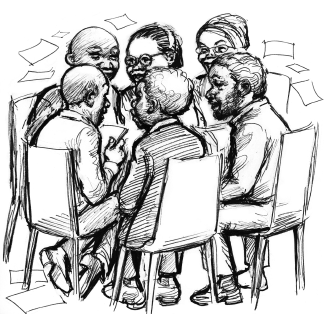
PURPOSEWhat will our country look like in 2020? In 1994, at the dawn of a democratic era in South Africa, our hopes were writ large in the narrative of liberty. There was a vision both of nationhood for all and of substantial improvement in the quality of life for the victims of apartheid. Even those who had been part of the previous oppressive minority were buoyed by a sense of new-found pride in a nation that could hold its head high in the global community. In the 15 years of our democracy, the realities of constructing a new nation have revealed themselves as an entirely grittier and more complex task than we had anticipated. Our legacy challenges us once more with the task of reconstruction. We have not yet vanquished our past; nor have we yet fully constructed our future. In response to these predicaments, a group of 35 South Africans from a wide spectrum of our society gathered together to probe our country�s present, and to consider possible futures. The purpose was to engage citizen-leaders from all corners of South Africa in a discussion about our future: �To create a space and language for open, reflective and reasoned strategic conversation among South Africans, about possible futures for the country, and the opportunities, risks and choices these futures present.� This purpose was built on the premise that a more engaged citizenry would contribute to the consolidation and strengthening of democracy in South Africa. The Scenario Team comprises leaders from civil society and government, political parties, business, public administration, trade unions, religious groups, academia and the media. They were brought together by six convenors, all of whom are actively engaged in our national issues. They are Dr Mamphela Ramphele, who chairs the convenor group, Archbishop Njongonkulu Ndungane, Mr Bob Head, Ms Gra�a Machel, Dr Vincent Maphai and Mr Rick Menell. The exercise has been generously sponsored by Old Mutual and Nedbank who have provided the funding, together with project, infrastructure and logistical support. The Old Mutual Group believed that the time was right to create an opportunity for healthy debate about the future of the country. They also decided that the initiative should be conducted in the public interest; the agenda and outcome would be determined by the participants and the results published in the public domain. The Scenario Team met in the north-eastern corner of Gauteng known as Dinokeng. Dinokeng is in a catchment area between two rivers and its name derives from the Sepedi word meaning �a place where rivers flow together.� The location captured the spirit of the dialogues: a flowing together of ideas and perspectives in the forging of a common future. It also gave its name to the scenarios the Team produced: the Dinokeng Scenarios. With their deep collective experience and expertise, and with input from experts in various fields, the Scenario Team considered our key accomplishments and failures since 1994, and the critical challenges that lie ahead. The Team is diverse; a group of individuals with widely differing perspectives and experiences. They debated robustly and did not agree on everything. What they do share is a common commitment to the principles of our Constitution, an appreciation of the heritage of our past, and a very real concern about how they, as citizens, can contribute to the construction of a sustainable future for South Africa. What follows is a presentation of the Team�s efforts in the hope that this work will contribute to the national dialogue, and ultimately to a future that lives up to the promise of 1994.
|
VOICES OF DINOKENG
Perspectives from members of the Dinokeng Scenario Team. We have chosen Dinokeng, �a place of rivers�, because all our pasts have flowed together to meet at this place and time, and all our futures will flow from here. These beautiful surroundings remind us of how beautiful South Africa is. We have accomplished much as a young democracy, and we need to remember this, but our moments of triumph are our moments of great vulnerability. The gap between the promise of freedom and daily reality is growing into a chasm of despair. The best defence of the gains is the creation of an inclusive future. We have succumbed to triumphalism, and denialism of what has not gone so well. We need to move to a level of maturity, to an acceptance of our vulnerability. We need to turn our challenges into opportunities to reshape our future. With this Dinokeng exercise we should try to give South Africa a report about the need to be vigilant about what is happening around us, and do this regardless of our political affiliations. We need to build South Africa together so that we can leave a good future for our children, one with respect for others and for self. I grew up in a struggle culture and have high aspirations for our people and our nation. Suddenly we find this dream unravelling. We had this beautiful vision for the country. Sometimes in my quiet moments I now have mixed feelings of happiness and disappointment. I want to contribute to this Dinokeng exercise in the hope that together we can make a small contribution to fundamentally changing the country�s future course. If you study countries in transition you will see a �mood pattern�. It�s a global trend. Look at Southern Europe, South America; it always starts with euphoria. Mandela represents our euphoria. We still rely on the Mandela magic. We haven�t taken responsibility at a very subconscious level. We expect from the world that we have given them Mandela and they must give us the cheque. We believe in the miracle, and then we discover that it�s not the way the world works. We move to disillusionment. That�s where we are now. Both euphoria and disillusionment are a mistake. We are in a period of transition in which making proportionate decisions is difficult. Both euphoria and disillusionment are disproportionate responses. We are as South Africans capable of realising the country�s potential, if only we are able to dig deep into ourselves to find the resolve to do so. |