| HOME | OVERVIEW | MEDIA CENTRE | MATERIALS | SOUTH AFRICA TODAY | THE SCENARIOS | REFERENCES | EVENTS |
 |
| Currently viewing: South Africa today / Our Assets / Social Achievements |
|


OUR ASSETSSocial Achievements We have made some substantial improvements on the social front, especially in relation to education, health and crime; all three critical indicators of personal wellbeing, economic opportunity and social stability and cohesion.
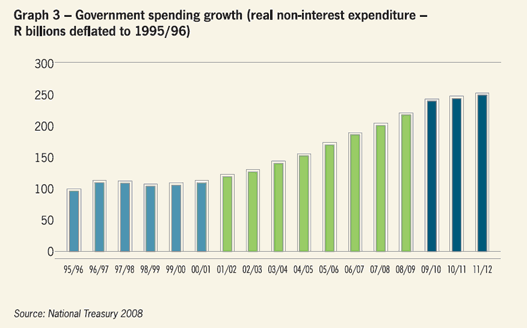
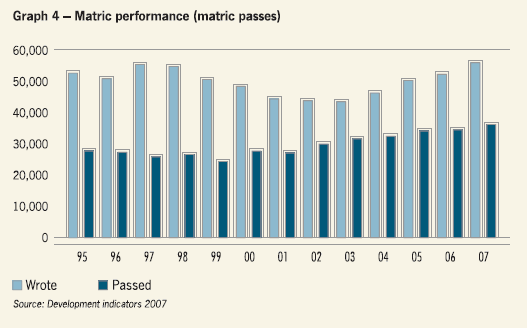
Education A nation is built on its people, its skills, and its education system. It is this recognition that has seen education consuming the biggest slice of non-interest expenditure in the Budget since 1994. Today that proportion is over 20%. Education expenditure in 2008 was R127.3 billion, which is approximately 5.5% of GDP. The introduction of compulsory education has significantly increased school enrolment in the past 15 years. Primary school enrolment is around 97%, and secondary school enrolment is 92% for girls and 85% for boys.11 Unlike in the past where apartheid education was highly unequal, education has been integrated. There have been notable increases in the budget allocation to no-fee schools in the past few years. In this year's budget no-fee schools rose from 40% to 60% of the total number of schools. In addition, there have been significant further budget allocations to higher education and to the school nutrition scheme.12 Over the next three years government has, among other things, committed itself to extending the range of no-fee schools, improving the skills of teachers by introducing independent national evaluators, and to recapitalising 100 technical schools.13 Matric pass rates have increased from 58% in 1994 to about 63% in 2008, although marginally down from the previous year's 65%. In addition the total number of matriculants with mathematics passes increased from 95,000 in 1997 to 149,228 in 2007.14
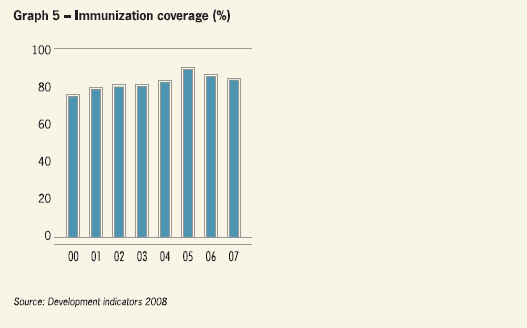
We have increased access to higher education and increased the proportion of black students at universities. The universities have transformed themselves in terms of race, class and gender representivity and have repositioned higher education as part of the reconstruction of our country. Innovative partnerships between government, universities and the private sector to promote science development have led to a number of universities achieving a world ranking. Health In 1994, South Africa's health spending as a percentage of GDP was among the highest in the world, yet "the country was not among the top 60 in terms of health status indicators and compared poorly with many of its African neighbours in terms of health outcomes."15 In 1993 under apartheid, 60% of health expenditure was targeted to a mere 23% of the population. The new government acknowledged the need to improve the healthcare provided to all of its citizens. Expenditure on health, which amounted to R80.8 billion in 2008/9,16 is the second biggest item of non-interest expenditure on the Budget, and at more than 3.5% of GDP, is on a par with many developed countries. Since 1994, more funds have been allocated to primary healthcare. To make it more affordable, primary healthcare fees were eliminated in 1996. Patient visits to primary healthcare clinics increased from 67 million in 1998/99 to 102 million in 2007. Routine immunisation coverage is now about 90%.17
Malaria has decreased significantly, particularly in the Maputaland and Lebombo areas in KwaZulu-Natal, where it has decreased by 99%. This is as a result of effective cross-border co-operation with neighbouring states, as well as innovative partnerships with the private sector. Nationally malaria has decreased from more than 13,000 cases in 2004/05 to about 5,000 in 2008.18 Crime In 1994, South Africa inherited a criminal justice and policing system that was entirely inappropriate for its human rights culture. The police had been used primarily to contain and suppress political opposition among the disenfranchised majority. Crime investigation relied on old methods of coercion rather than investigative techniques. The justice system was dysfunctional, creating a vacuum that was filled by semi-organised and organised crime, which increased during the transition to democracy.
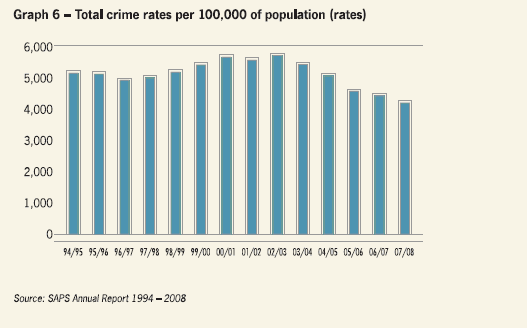
In response, the government set up the National Prosecuting Authority in 1998, provided for by the Constitution, to combat organised crime. The Authority included an innovative but controversial unit, the Directorate of Special Operations (DSO), which combined investigative and prosecutorial capacity. This unit was able to pursue cases from investigation to successful prosecution, thereby obviating the risk that effective investigation could be stymied by inept prosecution, corruption, bottlenecks or lacunae in the court system. There were several successful prosecutions against organised criminal gangs and against corrupt individuals in business and government. In the past five years, there has been a slow decrease in the number of 'violent contact crimes'. In 2008, 18,487 cases of murder were reported to the police, compared with 21,533 in 2002/03.19 |
VOICES OF DINOKENG
Perspectives from members of the Dinokeng Scenario Team. In the longer term, if we focus on education we can produce a good future. We need an education system which produces outstanding people, in the same way that the old missionary schools produced many of our great leaders. We need to invest in a system that produces people who have good values, who believe in authority and dignity. Such maturity might address the mediocrity in our teachers. First among our short-term priorities is that we must improve policing and reduce crime. If we stamp out crime, everything else will follow. There must be no compromise on mediocrity masquerading as leadership. Fix crime and we will change people’s psyches.
|